
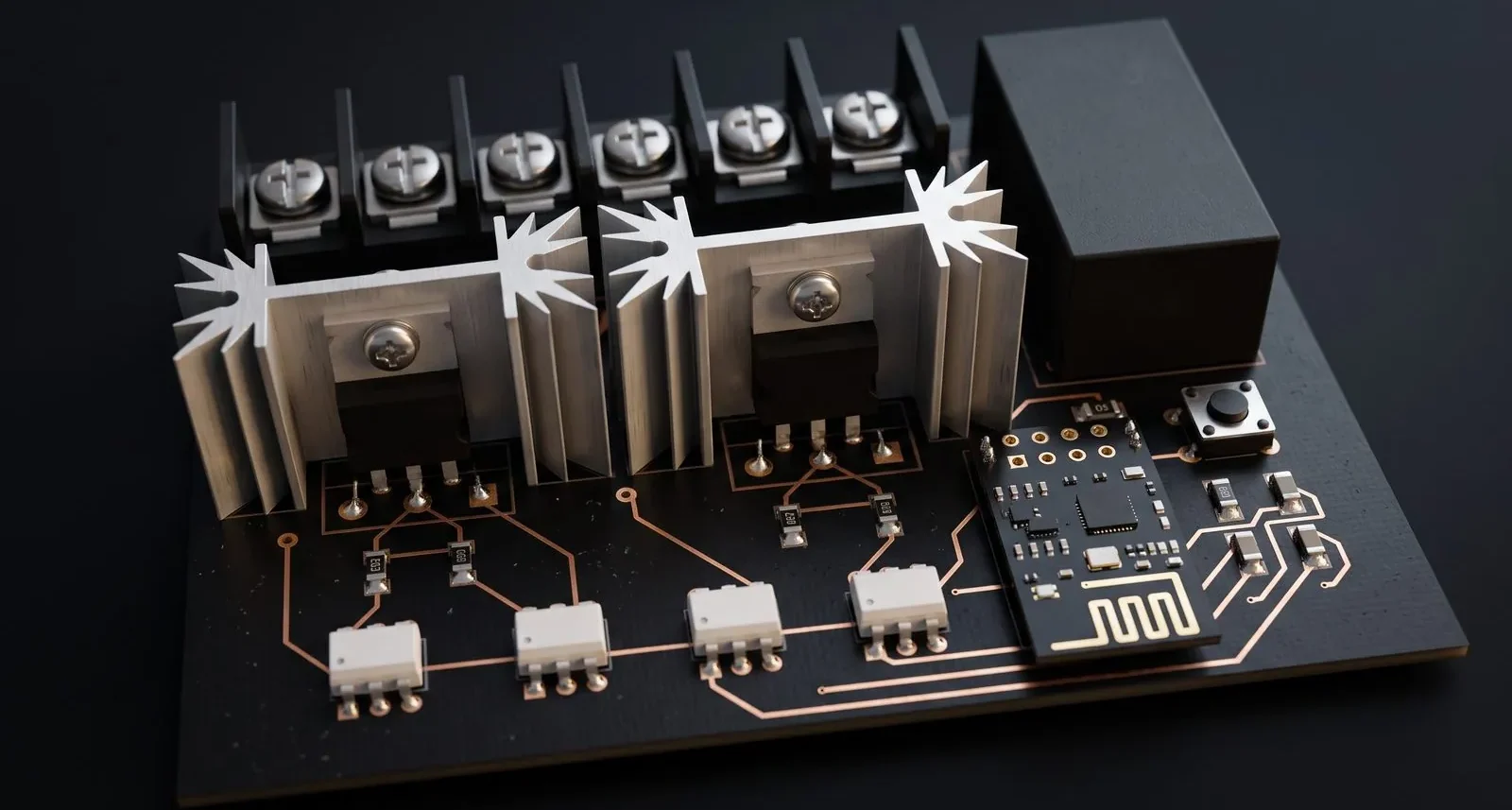
ESP8266-01 Home Automation Board
Solid-state relay board for ESP8266-01, no mechanical relays.
The brief
This board sits directly on mains voltage, so the starting constraint is not the ESP8266 or the Wi-Fi but where the safety boundary goes. Mains in, four AC loads out, and nothing on the logic side allowed to be connected to either.
The answer here is optocoupler isolation on every channel, with the microcontroller driving triac gates through a transistor rather than anywhere near the load current.
What we did
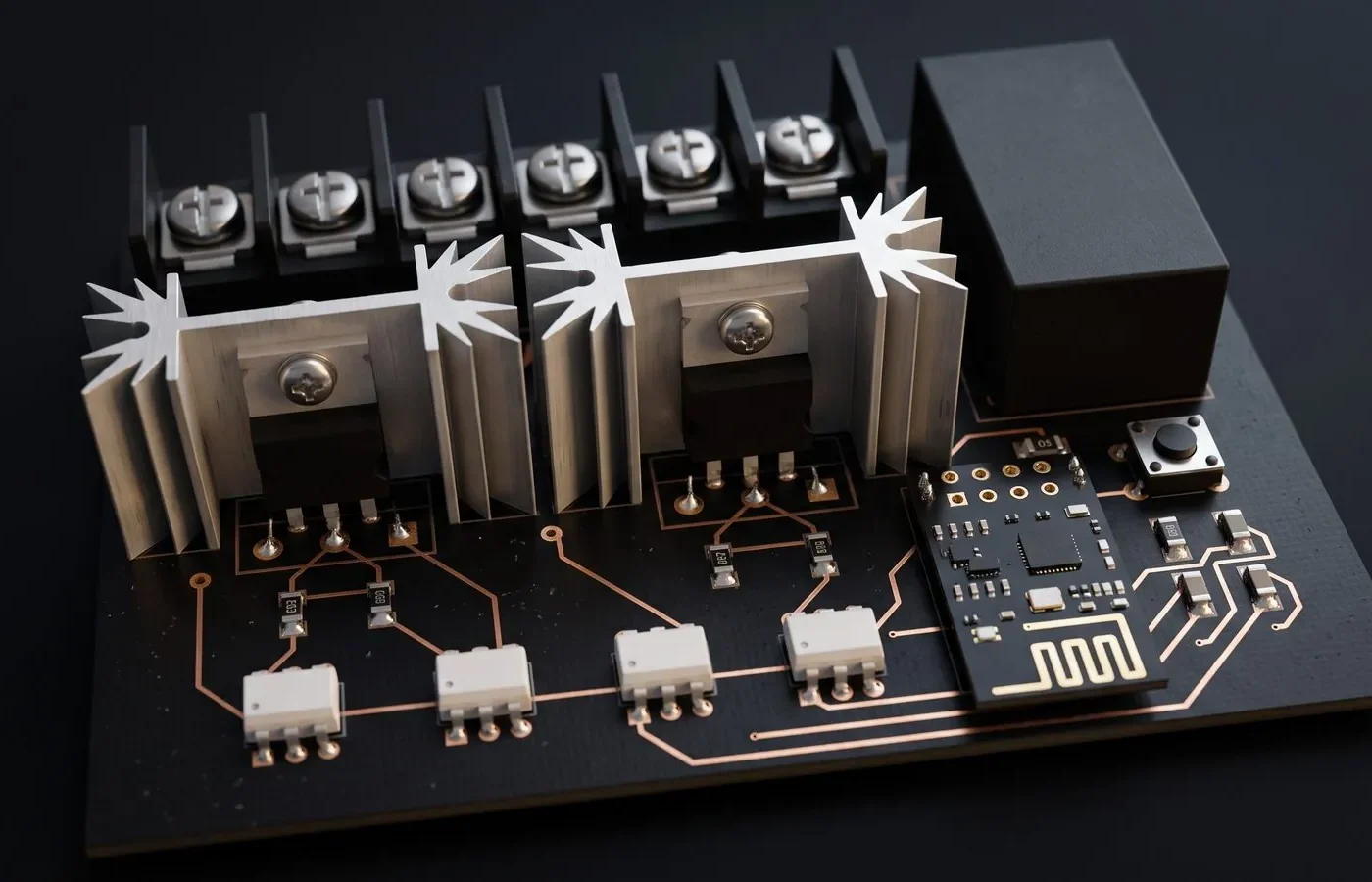
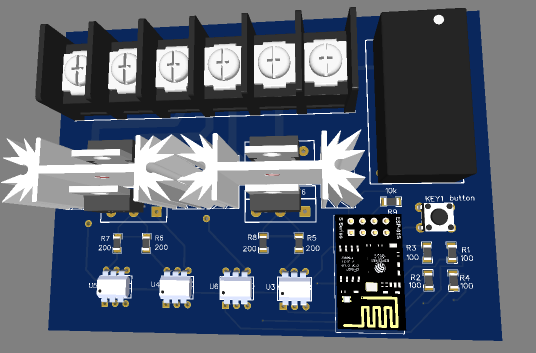
A mains-powered smart switch board that lets four AC loads, such as lights, fans or appliances, be turned on and off over Wi-Fi. It is built around an ESP8266 (ESP-01) module, and the high-voltage side is electrically isolated from the logic side.
- Wi-Fi control: The ESP8266 module hosts the connectivity and switches four output channels from its GPIO pins. A push button on the board is used for reset and flashing.
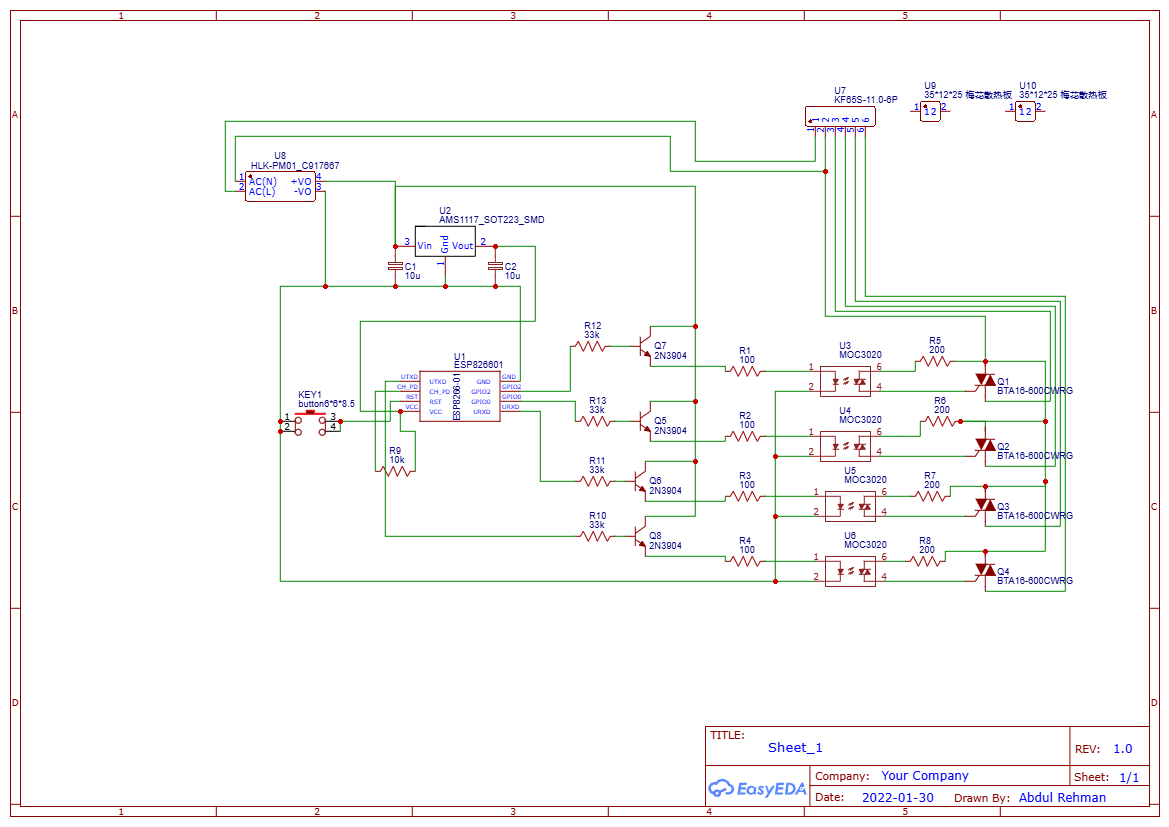
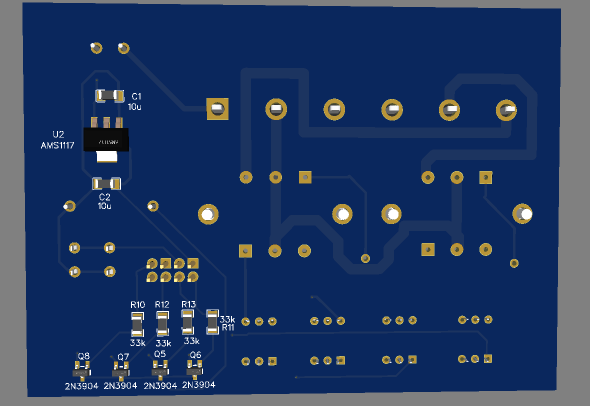
- Direct mains power: An HLK-PM01 AC-DC module converts mains voltage to 5 V, and an AMS1117-3.3 regulator provides the 3.3 V the ESP8266 needs, with bulk capacitors on both rails.
- Isolated switching: Each channel uses a MOC3020 optocoupler triac driver, so the microcontroller never touches mains voltage. 2N3904 transistors drive the optocoupler LEDs from the ESP8266’s low-current pins.
- Power triacs: Four BTA16-600CWRG 16 A, 600 V triacs switch the loads, with 200 Ω gate resistors and heatsink mounting for sustained current.
- Connectors: A 6-pin screw terminal block brings in the mains and takes out the four switched loads.
Design details
Design summary
| CAD tool | EasyEDA |
|---|---|
| Overview | A mains-powered smart switch board that lets four AC loads, such as lights, fans or appliances, be turned on and off over Wi-Fi. |
| Wi-Fi control | The ESP8266 module hosts the connectivity and switches four output channels from its GPIO pins. |
| Direct mains power | An HLK-PM01 AC-DC module converts mains voltage to 5 V, and an AMS1117-3.3 regulator provides… |
| Isolated switching | Each channel uses a MOC3020 optocoupler triac driver, so the microcontroller never touches… |
| Power triacs | Four BTA16-600CWRG 16 A, 600 V triacs switch the loads, with 200 Ω gate resistors and heatsink… |
| Connectors | A 6-pin screw terminal block brings in the mains and takes out the four switched loads. |
Have a board like this?
Send us the schematic, the mechanical constraints and the deadline. We will tell you what it takes and what it costs.