
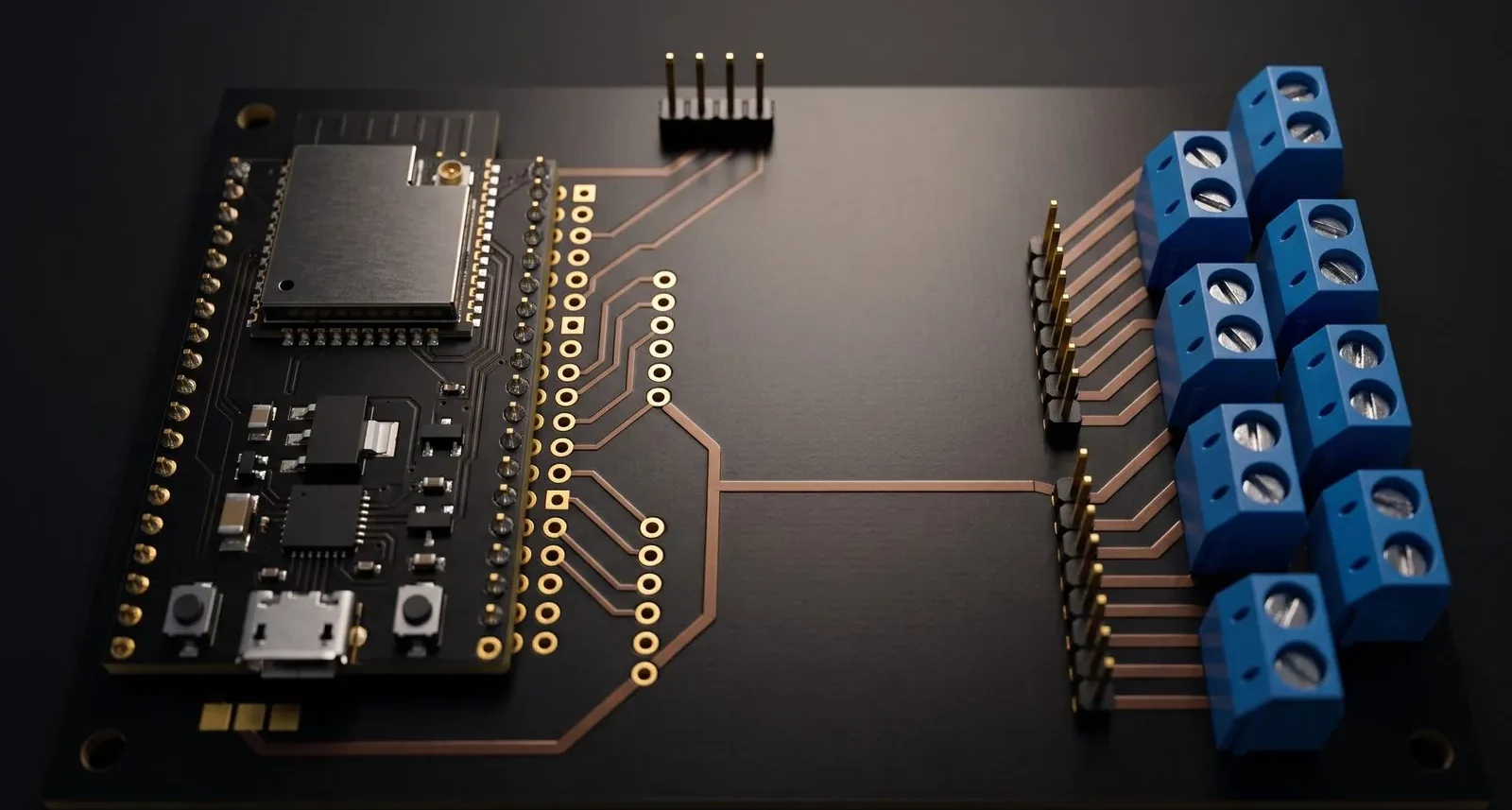
ESP32 Solid-State Relay Board
ESP32 relay board using solid-state relays, fabrication-ready for PCBWay.
The brief
Eight outputs from a single board, but built from plug-in modules rather than discrete parts. That choice makes the board a carrier, which shifts the design problem from circuit design to mechanical and electrical integration: mounting, screw terminals, and keeping every control line routed where it cannot pick up the switching transients.
Solid-state switching is silent and has no mechanical life, which is the reason this arrangement is worth building in the first place.
What we did
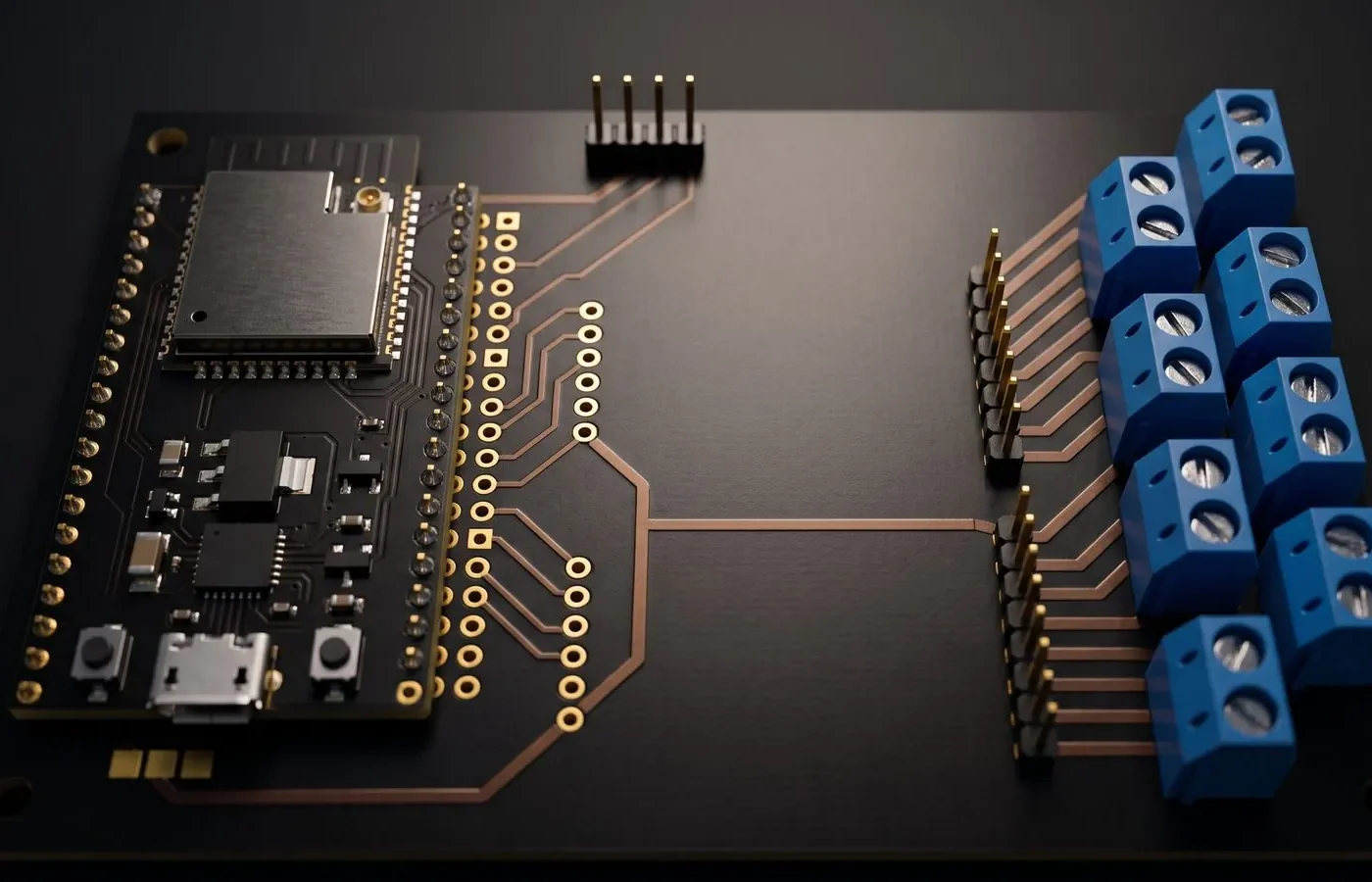
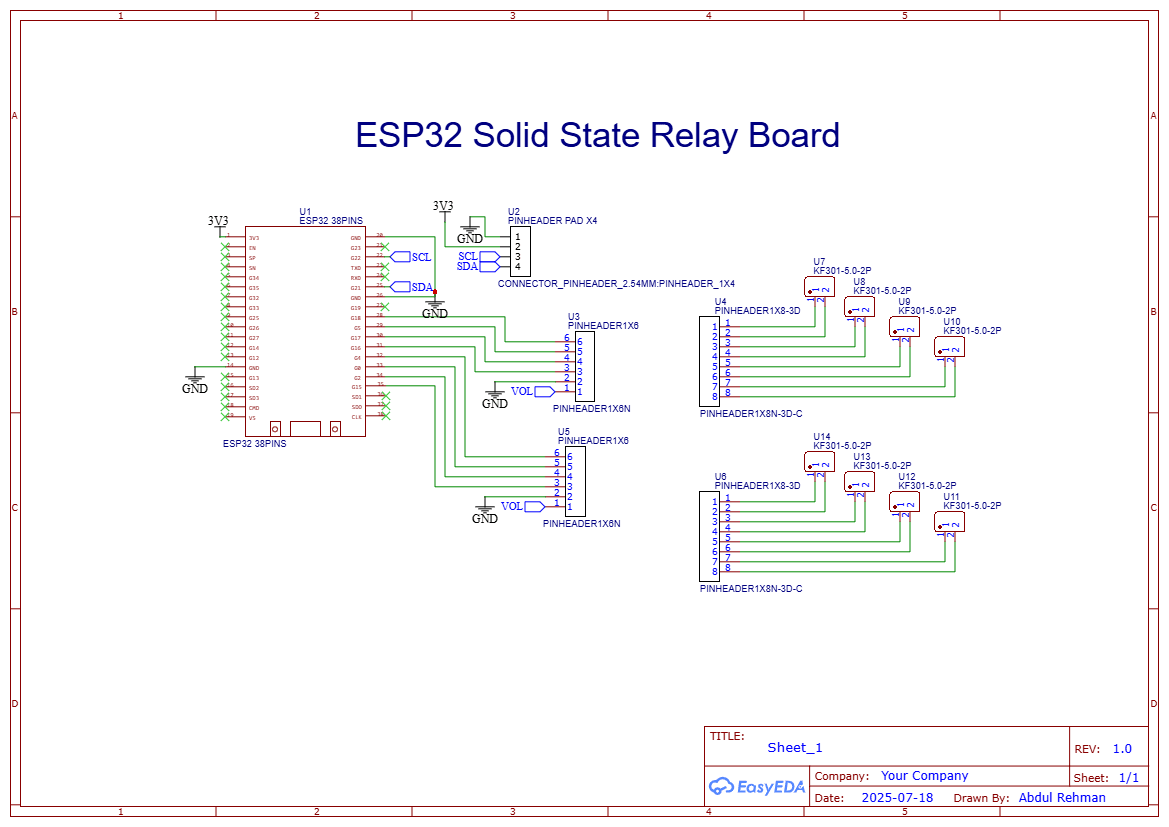
A modular control board that carries an ESP32 development board and two solid-state relay (SSR) modules, giving eight independently switched outputs. It is a compact, silent-switching alternative to a mechanical relay board.
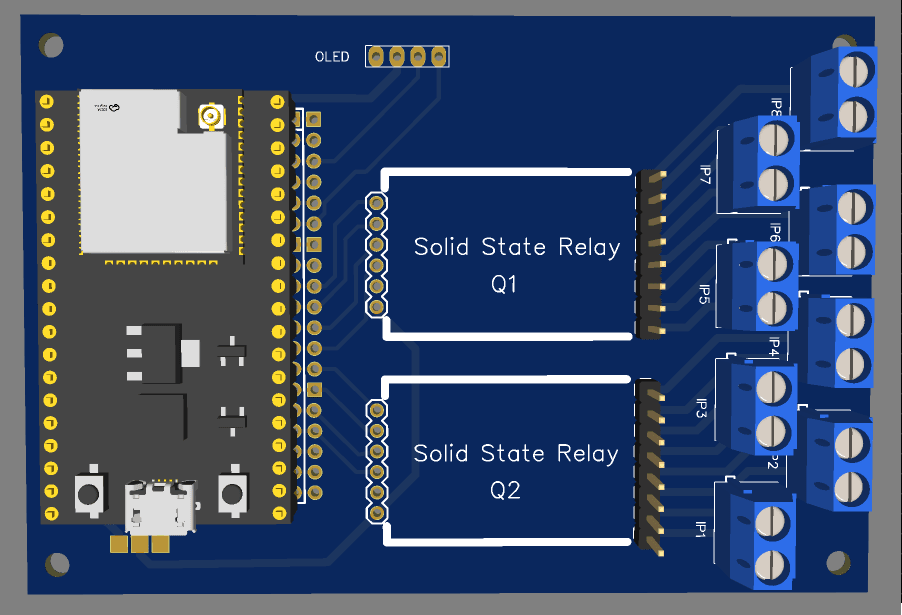
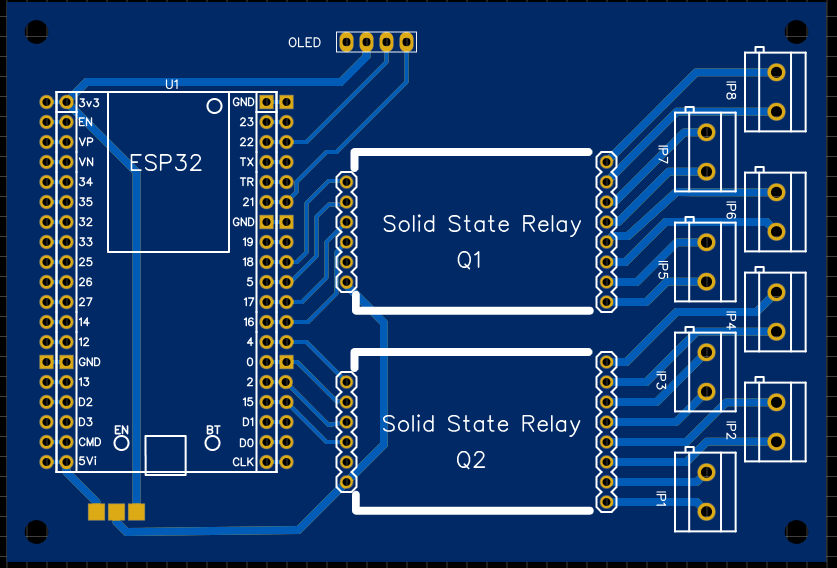
- Plug-in ESP32: A 38-pin ESP32 dev board plugs into female headers, so it can be replaced or reprogrammed without desoldering. Spare GPIO pins are available through the headers.
- Solid-state switching: Two plug-in SSR modules (Q1 and Q2), each with 4 channels, give 8 switched outputs. Solid-state relays have no moving parts, switch silently and suit frequent switching.
- Screw terminal outputs: Eight 2-pin screw terminals (IP1 to IP8) bring the switched circuits out for easy field wiring.
- Dedicated control lines: Each module has its own 6-pin header carrying the ESP32 control signals and its supply connection, with the signals routed in an orderly way from the ESP32’s GPIO pins.
- OLED display header: A 4-pin I2C connector (3.3 V, GND, SCL, SDA) allows a small OLED to show status.
- Mounting and layout: The board has four corner mounting holes and a solid ground pour. The relay modules are placed side by side with clear isolation spacing, and the outputs are on one edge, away from the ESP32.
Design details
Design summary
| CAD tool | EasyEDA |
|---|---|
| Overview | A modular control board that carries an ESP32 development board and two solid-state relay (SSR) modules, giving eight independently switched outputs. |
| Plug-in ESP32 | A 38-pin ESP32 dev board plugs into female headers, so it can be replaced or reprogrammed… |
| Solid-state switching | Two plug-in SSR modules (Q1 and Q2), each with 4 channels, give 8 switched outputs. |
| Screw terminal outputs | Eight 2-pin screw terminals (IP1 to IP8) bring the switched circuits out for easy field wiring. |
| Dedicated control lines | Each module has its own 6-pin header carrying the ESP32 control signals and its supply… |
| OLED display header | A 4-pin I2C connector (3.3 V, GND, SCL, SDA) allows a small OLED to show status. |
| Mounting and layout | The board has four corner mounting holes and a solid ground pour. |
Have a board like this?
Send us the schematic, the mechanical constraints and the deadline. We will tell you what it takes and what it costs.