

Pico Handheld Game Console
Handheld console with analog joystick, colour LCD and adjustable buzzer.
The brief
A handheld game has to work in the hands: an analog joystick that does not drift out of its range, a colour display that is readable, and sound with volume the player can actually change. All of it on a Raspberry Pi Pico, which is a small processor with no display and no audio hardware.
The board therefore has to add a display interface, an analog input, a buzzer and a switch, in an arrangement that survives being carried around.
What we did
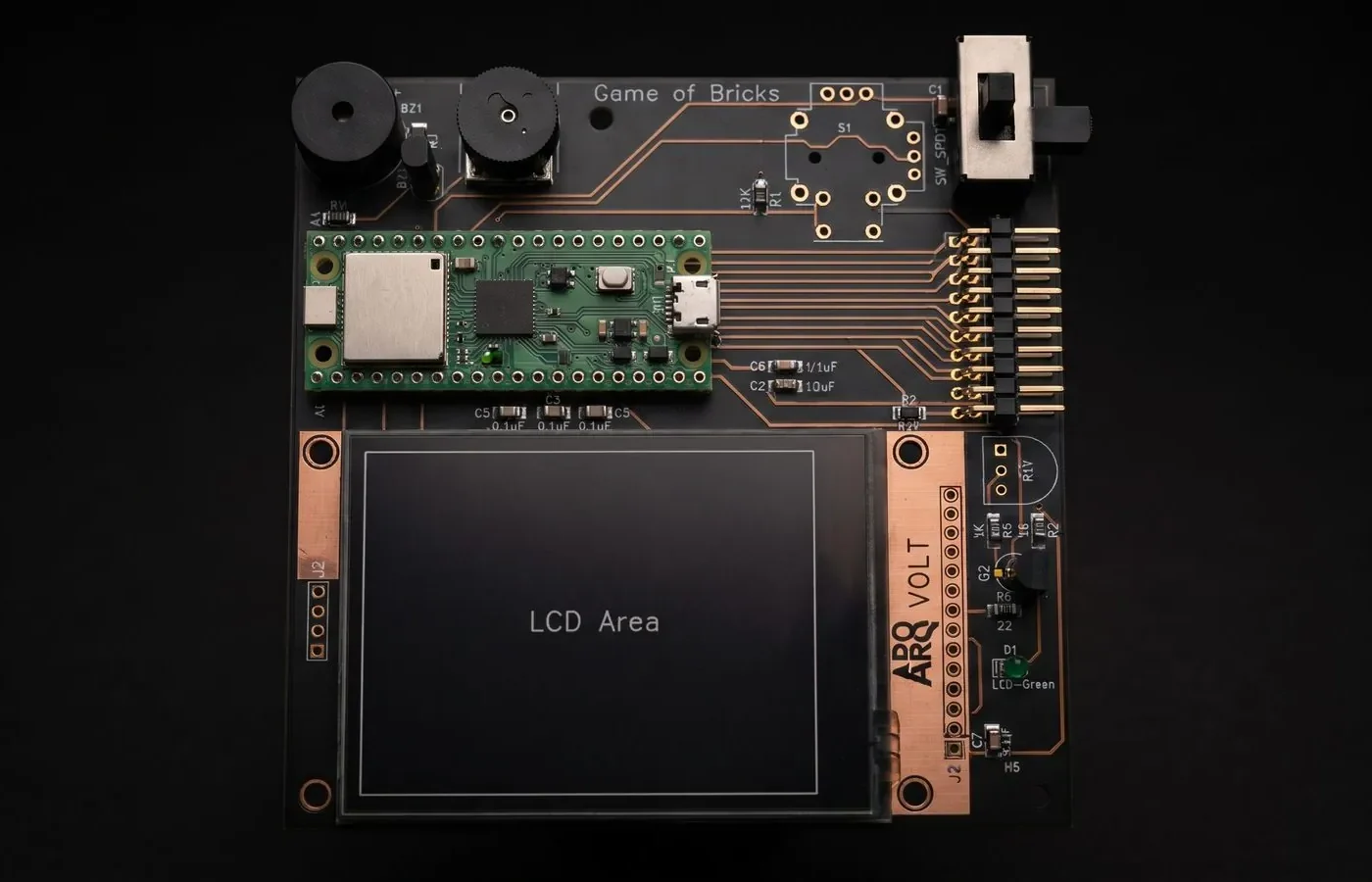
A small handheld game board built around a Raspberry Pi Pico. It has an analog joystick, a color LCD, a buzzer with volume control and an on/off switch, and it is designed for retro-style games such as brick breaker.
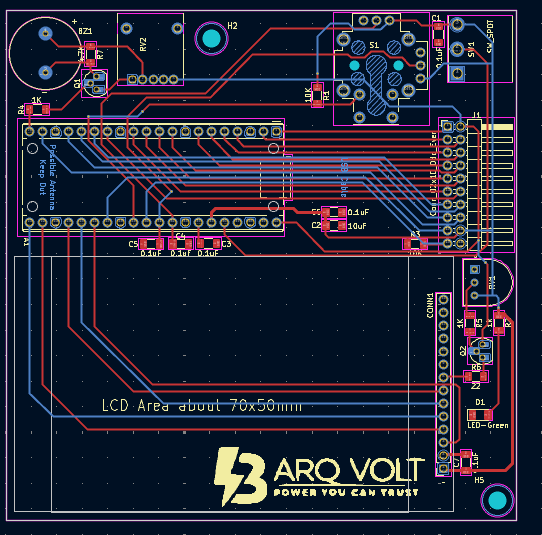
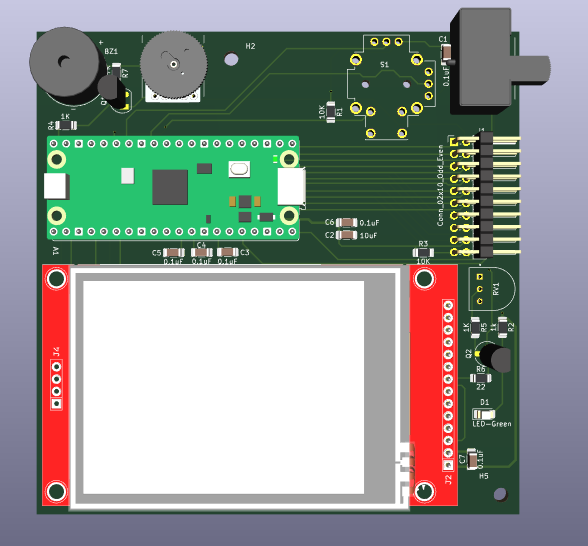
- Main controller: The Raspberry Pi Pico (RP2040) runs the game, powered from USB (VBUS) through a slide power switch.
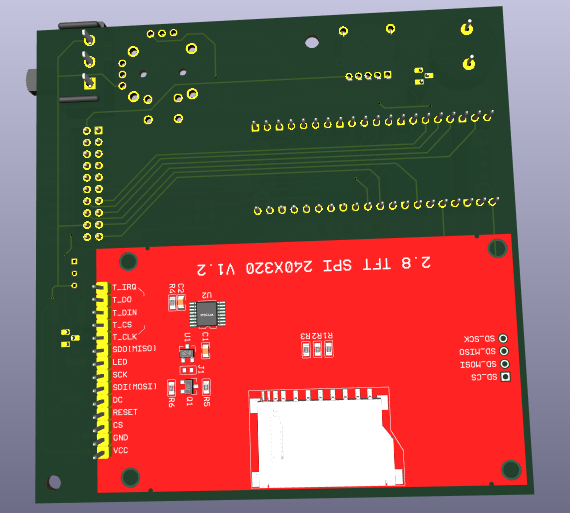
- Display: A 14-pin SPI LCD connector (DC, reset, clock, MOSI, chip select) with a transistor-driven backlight. A potentiometer adjusts the backlight brightness.
- Joystick input: A two-axis analog joystick feeds the Pico’s ADC pins, with a push-button for select/fire. Each ADC input has decoupling for stable readings.
- Sound: A buzzer driven through a transistor, with a potentiometer for volume control.
- Expansion: A 2×10 header breaks out spare GPIO pins for extra buttons or sensors.
- Status indicator: A green power LED with a current-limiting resistor.
- Mechanical: Mounting holes are included in the layout.
Design details
Design summary
| CAD tool | KiCad |
|---|---|
| Overview | A small handheld game board built around a Raspberry Pi Pico. |
| Main controller | The Raspberry Pi Pico (RP2040) runs the game, powered from USB (VBUS) through a slide power… |
| Display | A 14-pin SPI LCD connector (DC, reset, clock, MOSI, chip select) with a transistor-driven… |
| Joystick input | A two-axis analog joystick feeds the Pico’s ADC pins, with a push-button for select/fire. |
| Sound | A buzzer driven through a transistor, with a potentiometer for volume control. |
| Expansion | A 2x10 header breaks out spare GPIO pins for extra buttons or sensors. |
| Status indicator | A green power LED with a current-limiting resistor. |
| Mechanical | Mounting holes are included in the layout. |
Have a board like this?
Send us the schematic, the mechanical constraints and the deadline. We will tell you what it takes and what it costs.